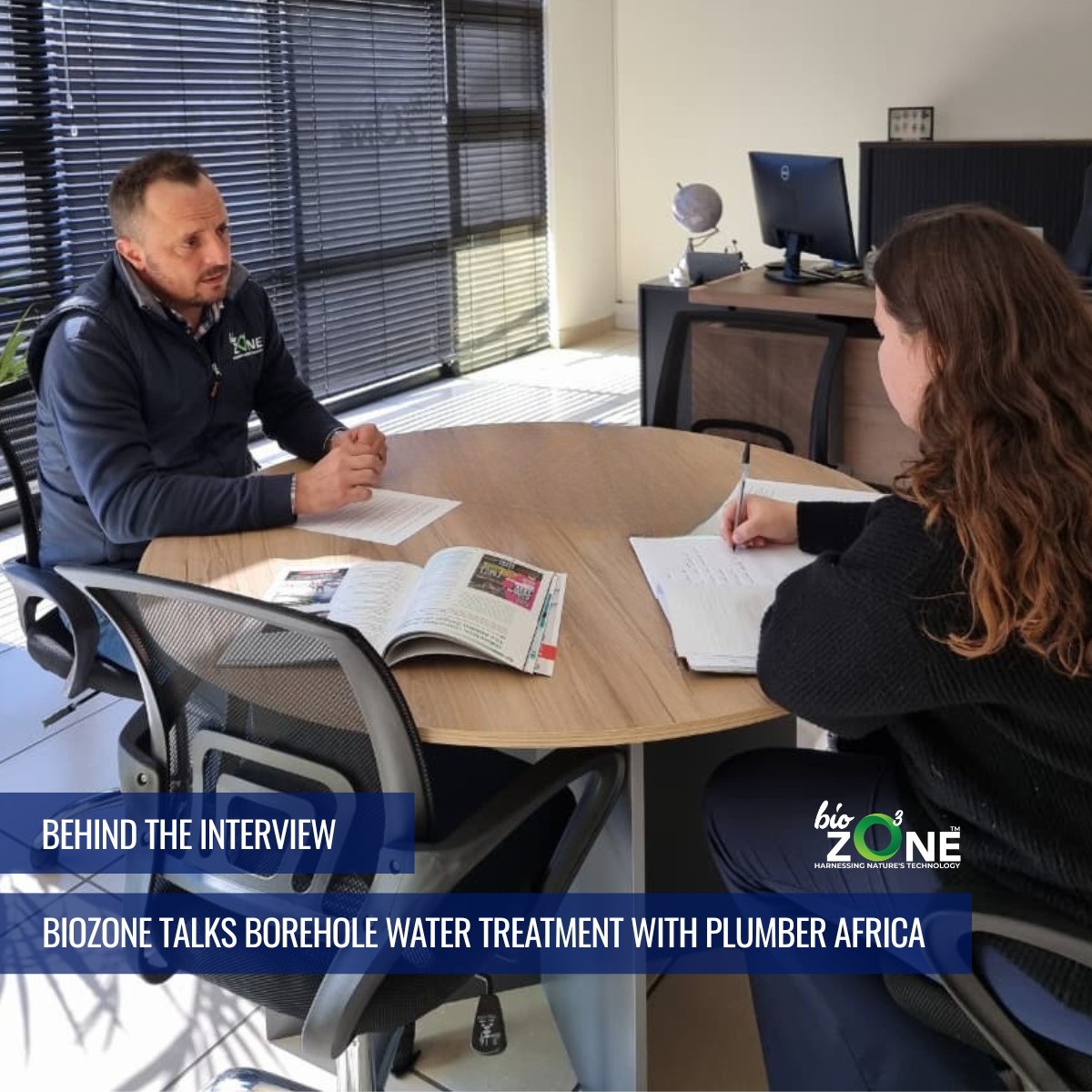
This week, Biozone Manufacturing sat down with IMD Media at our Randburg head office for an in-depth interview to be featured in Plumber Africa Magazine. The publication has covered one of our customer water treatment installations, and this follow-up conversation dug deeper into the technical side of borehole water treatment from contamination risks to maintenance best practice.
Our MD, Wesley Van Der Giessen, took the questions head-on and here’s what came out of the conversation.
Not All Borehole Water Problems Are the Same
Borehole water quality is highly site-specific. A borehole near an industrial area, farming property, or informal settlement carries a very different risk profile to one in a typical residential area, where seepage over time can introduce contaminants.
That said, some issues come up again and again in residential boreholes:
- Iron
- Manganese
- Total hardness (calcium)
- Bacterial counts
Every Biozone project starts the same way with a proper water analysis. Our analysts assess the specific results for that borehole and design a site-specific treatment process to bring the water in line with South African and international drinking water standards.
Why Ozone and UV
UV and ozone both play a role in eliminating bacteria without relying on harsh chemicals like sodium hypochlorite (chlorine). But ozone does more than disinfect it also oxidises heavy metals such as iron and manganese, tackling two problems at once. It’s widely regarded as the healthier, more natural, and safer disinfection method for drinking water treatment.
Where does pre-filtration fit in? Typically, water passes through activated carbon (GAC), activated glass media (AFM), and softeners before it reaches purification steps like reverse osmosis, nano filtration, or ultra filtration. This removes the bulk of contaminants first. UV and ozone then come in post-purification, sterilising and disinfecting to eliminate any residual bacteria.
The Installation Mistake That Undermines Everything
A well-designed system is only as good as its installation. Wesley pointed to a common issue in the industry: UV and ozone systems that are incorrectly sized for the site, rendering the technology far less effective than it should be.
At Biozone, sizing is calculated against two factors the bacterial and contaminant load in the water, and the site’s required daily water consumption. Get that wrong, and even good equipment underperforms.
Maintenance Isn’t Optional
Systems need upkeep to keep performing at their peak. Biozone recommends clients take out a Service Level Agreement (SLA), which protects the warranty on all equipment in the treatment plant. Beyond the standard 12-month warranty period, Biozone technicians can support third-party plumbers or in-house teams with ongoing maintenance.
A Shift Toward Alternative Water Sources
Perhaps the most telling insight from the interview: municipal water supply reliability has become a genuine concern for many businesses and residential properties, prompting a shift toward alternative sources most commonly boreholes, but also rainwater harvesting and river or dam supply.
Wesley’s advice is consistent regardless of the source: get the water tested first. Those results, shared with a water expert at Biozone, form the basis for a treatment process that makes the water safe not just for drinking, but for the building’s infrastructure, including pipework, geysers, and plumbing systems.
What’s Next
It was a great morning hosting Megan from IMD Media at our Randburg facility, and we’re looking forward to seeing the feature go live in Plumber Africa Magazine. Publishing date is still to be confirmed watch this space, and follow Biozone on LinkedIn and Facebook for the announcement.
In the meantime, if you’re dealing with borehole water quality issues, or considering an alternative water supply for your business or home, get in touch with our team.