Food and beverage manufacturing
Food and beverage plants face a constant battle with pathogen load on surfaces, equipment, and process water. Ozone disinfection eliminates the need for chlorine-based sanitisers in many wash and rinse applications, reducing both chemical residue risk and the chemical oxygen demand (COD) load going to drain. Multiple peer-reviewed studies support this: aqueous ozone has demonstrated 5-log reductions in pathogens such as E. coli O157:H7 and Salmonella on produce and food-contact surfaces, with food-processing reviews reporting reductions of 99.99% to 99.9999% across a range of organisms including Listeria monocytogenes, Campylobacter jejuni, and Pseudomonas aeruginosa. For practical industry guidance on implementing ozone in processing environments see an overview of ozone in food and beverage processing and a technician-focused article on how ozone is used in the food and beverage industry.
Bottling, dairy, and clean-in-place applications
Bottling plants and dairy processors benefit particularly from ozone because clean-in-place (CIP) cycles can replace hot chemical washes with aqueous ozone, cutting energy and chemical costs in the process. Ozone decomposes to oxygen and does not leave persistent disinfectant residues, thereby reducing the risk of sanitiser carryover compared with many chemical sanitisers. This is why facilities running at beverage-grade hygiene standards, including some of the largest food producers such as Tiger Brands, have moved to ozone-based sanitation for specific process stages. At least one food-industry study has found aqueous ozone outperforming 1% peracetic acid in bottling machine sanitation at comparable contact times.
Shelf life, export compliance, and food storage
South African food exporters face international market access requirements around pesticide residues and food safety documentation. Ozone treatment of storage environments and wash water helps facilities meet those benchmarks while also extending product shelf life. Research on white fish has pointed to shelf-life extensions of approximately 50% under ozone treatment, and trials on fresh produce categories have reported measurable improvements, though results vary by species and treatment conditions. For facilities targeting European or UK export markets, this is not a marginal benefit. It directly affects whether produce arrives in-specification or gets rejected at the border.
Mining and chemical processing: compliance under pressure
South African mining operations deal with highly contaminated process water, including acid mine drainage carrying elevated heavy metal loads and high biological oxygen demand. Industrial ozone systems accelerate the oxidation of dissolved metals: ferrous iron (Fe²⁺) is rapidly converted to ferric iron (Fe³⁺), which then hydrolyses and precipitates as insoluble iron hydroxides, making downstream neutralisation and solids removal significantly more effective. Manganese is similarly converted to MnO₂ and precipitated, and ozone can efficiently oxidise free cyanide and thiocyanate in mine water when properly dosed. This is particularly relevant in Gauteng, Limpopo, and the Northern Cape, where mine water management is under active regulatory scrutiny.
Meeting National Water Act discharge requirements with ozone wastewater treatment
Chemical processing facilities face the same pressure from a different angle. The National Water Act (Act 36 of 1998) sets binding effluent discharge standards. Commonly cited benchmark figures include BOD at 30 mg/L and suspended solids at 30 mg/L, while COD is typically set within a range of 75, 125 mg/L in guidance documents. Water use licences can impose stricter site-specific limits. Facilities that miss those limits face operational shutdowns and financial penalties. Ozone wastewater treatment gives plant engineers a controllable, chemical-light route to reducing COD and BOD in process streams before they reach the discharge point. High-compliance industrial environments represent exactly the kind of context where integrated ozone systems have demonstrated their operational value.
Agriculture and agri-processing: from irrigation to cold storage
South African agriculture faces growing pressure on water quality, particularly in regions where irrigation sources carry coliform bacteria or chemical runoff from upstream activity. Ozone treatment of irrigation water reduces pathogen load without introducing chemical residues that affect crop quality or soil biology. For export-facing farming operations, clean irrigation water is also a food safety compliance requirement under the Global G.A.P. and HACCP frameworks that govern access to European supermarket shelves.
Ethylene management and produce shelf life in packhouses
Post-harvest losses in South African packhouses are significantly driven by ethylene accumulation in cold storage environments. Cold-storage trials have shown ozone reducing ethylene concentrations from approximately 1.5 to 2 µL/L down to non-detectable levels in vegetable storage rooms, while apple and pear rooms maintained ethylene below 1 to 2 µL/L compared to untreated rooms reaching around 25 µL/L. Ozone in cold rooms and packhouse air treatment break down ethylene continuously, slowing ripening and reducing spoilage without quality penalties to the stored fruit at appropriate doses. Trials and review literature on ozone’s effects in cold storage provide further detail on quality and shelf-life outcomes for different produce types; see a technical review on the effect of ozone on fruits and vegetables in cold storage for practical results.
Reducing BOD and COD before effluent discharge
Industrial wastewater treatment is one of the most direct applications for ozone because the chemistry is clear: ozone oxidises organic compounds, reducing BOD and COD in the effluent stream and making the water easier and cheaper to treat downstream. Sectors like food manufacturing, textiles, and pharmaceuticals all generate high-organic-load wastewater that responds well to ozone treatment before discharge or internal reuse. Where facilities are already spending significantly on chemical dosing and sludge management, ozone can rationalise both cost lines simultaneously.
Closed-loop water reuse and DWS compliance
With South Africa’s water scarcity pressures intensifying, industrial facilities face growing incentive to reclaim and reuse process water internally rather than discharge it to the municipal system. Ozone disinfection for recycled water reuse closes the loop: treated effluent reaches a quality standard suitable for reintroduction into non-potable process water circuits. This reduces freshwater intake, cuts municipal water costs, and supports compliance with Department of Water and Sanitation (DWS) standards. Biozone has commissioned large-scale installations such as the Driefontein WWT project specifically designed for this model, where wastewater reuse in industrial applications replaces a meaningful portion of freshwater intake.
Aquaculture, cooling towers, and other high-gain sectors
Aquaculture and fish processing
Commercial aquaculture operations deal with high dissolved organic loads, persistent pathogen pressure, and stringent biosafety requirements. Ozone treatment of tank and recirculating water reduces pathogen levels and supports water quality without the residue risks associated with traditional disinfectants. In fish processing specifically, ozone systems have been shown to extend the shelf life of white fish by approximately 50%, which is directly valuable for processors targeting fresh-fish export markets where cold-chain integrity and shelf life at point of delivery determine whether their product is accepted or rejected.
Cooling towers and commercial building management
Cooling towers are a well-documented ozone application because stagnant water at ambient temperatures is the ideal environment for Legionella and biofilm growth. Ozone treatment controls both without the chemical handling risks associated with chlorine-based biocides, and it can reduce or in some cases remove the need for on-site bulk biocide storage, depending on system design and operational requirements. In commercial building management and hospitality, ozone also serves an air treatment function: odour control, VOC reduction, and improved indoor air quality in food storage and service environments. These are lower-volume applications compared to full industrial sectors, but the operational benefit is consistent and the compliance case for Legionella management is non-negotiable.
Practical considerations before adopting an ozone system in South Africa
Industrial ozone systems in South Africa are capital-intensive. Small to mid-scale commercial systems typically fall in the low hundreds of thousands to low millions of rand for capital expenditure, while larger industrial installations can reach the high single-digit millions depending on output requirements. Running costs are dominated by electricity consumption, oxygen feed gas, and maintenance. For food and beverage applications, where ozone replaces chemicals and hot water in sanitation cycles, payback periods of one to three years are commonly cited as a planning range based on project conditions. Mining and industrial water treatment applications typically carry longer payback horizons of three to six years, depending on site conditions and throughput volume.
South African regulatory and occupational safety requirements
Ozone in South Africa sits within a layered compliance framework. For water treatment, the relevant standard is SANS 241 for potable water quality, alongside the National Water Act for effluent discharge. For food processing, applicable food safety and hygiene legislation governs how ozone is used in food-contact and processing environments. Occupational safety falls under the Occupational Health and Safety Act and the Regulations for Hazardous Chemical Agents (RHCA), which classify ozone as a hazardous chemical agent and require employers to assess exposure risk. When exposure may exceed 50% of the occupational exposure limit, monitoring by an approved inspection authority is mandatory. Any industrial ozone installation must therefore address ventilation design, continuous monitoring, and emergency response protocols to comply with those requirements.
Identifying where ozone genuinely fits your operation
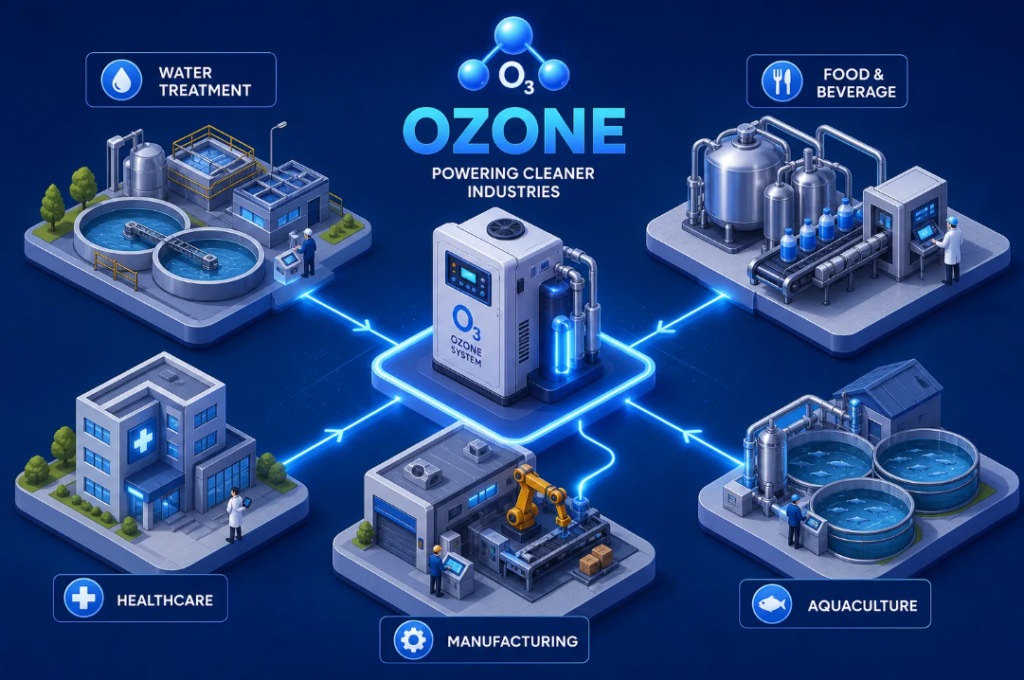
Understanding which industries in South Africa benefit most from ozone treatment systems comes down to a clear set of operational criteria. Ozone treatment systems are not a universal fit for every application, but for South African industries dealing with water quality, microbial control, chemical dependency, and regulatory compliance, they represent a technically mature and commercially viable solution. The sectors that see the greatest gains are those where chemical alternatives carry residue risk, where pathogen control is a compliance requirement, or where process water needs to meet discharge or reuse standards.
Biozone’s integrated approach, combining ozone with nanofiltration, reverse osmosis, and UV where the application demands it, is an example of how these systems can be designed, commissioned, and monitored to deliver accountable, measurable performance in demanding South African industrial environments. That end-to-end engineering model has been applied across a range of sector contexts, from large-scale wastewater reuse installations to food and beverage processing facilities.
If your facility operates in any of the sectors described above, the next step is to assess your water and compliance profile against the specific applications where ozone has demonstrated consistent results. Review your current chemical usage, effluent discharge obligations, and microbial control requirements, those inputs will tell you quickly whether ozone belongs in your treatment architecture or whether a different configuration makes more sense for your site. If you are unsure which industries in South Africa benefit most from ozone treatment systems and whether yours is among them, Biozone’s engineering team can assess your operation and provide a site-specific recommendation.